In my original article, The MTHFR Mutation: What It Is and What To Do About It, I discussed a few things. First, I went over what the mutations are and why they matter. Additionally, I explained how they’re connected to autoimmune disease and thyroid dysfunction.
In this article, we dive right into the importance of MTHFR tests. Most importantly, we discuss what you can do to reduce the impact of any MTHFR mutations on your health. In addition to Methylation Support®, this information will help you support methylation and detoxification pathways.
My motto is knowledge is power. Understanding your status by taking an MTHFR test is an empowering tool to take back your health!
The MTHFR Test
I recommend that everyone get an MTHFR test. I especially recommend it for women of childbearing age. This is because MTHFR mutations may increase the risk of miscarriage and birth defects. Getting an MTHFR test is also important if you have a history of thyroid or autoimmune disease. MTHFR contributes to those conditions as well.
Additionally, it never hurts to have newborns or young children tested. Determining which vaccines your child receives and when they receive them is a personal choice. Knowing your child’s MTHFR status may influence how vaccines affect their health. This is an important part of the decision. As a mother, making sure Elle got an MTHFR test was high on my priority list.
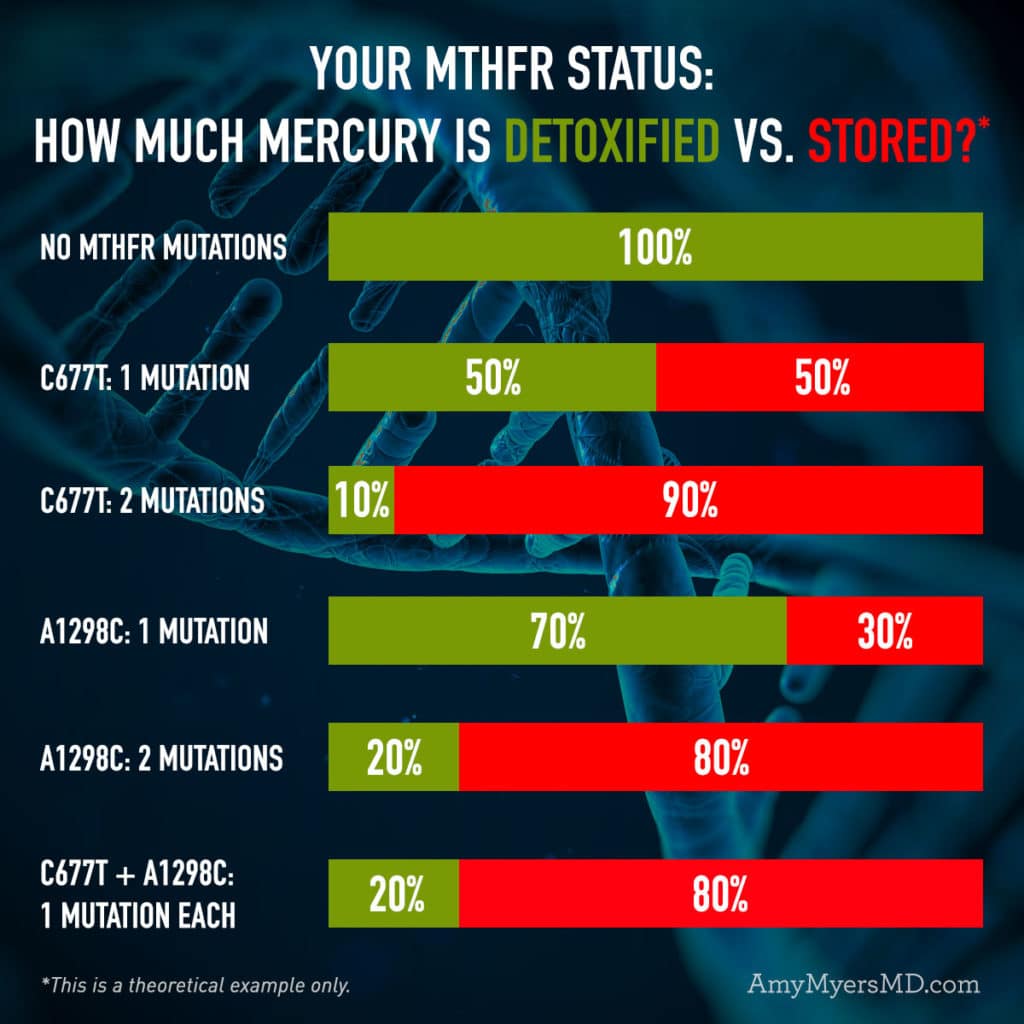
This is a theoretical illustration of how MTHFR mutations affect your ability to detoxify. As you can see, it demonstrates why it is so important for you to know your MTHFR status.
 Dr. Amy Myers
August 15th, 2024
https://content.amymyersmd.com/article/mthfr-test/Your MTHFR Status: How Much Mercury Is Detoxified vs. Stored – Infographic – Amy Myers MD®
Dr. Amy Myers
August 15th, 2024
https://content.amymyersmd.com/article/mthfr-test/Your MTHFR Status: How Much Mercury Is Detoxified vs. Stored – Infographic – Amy Myers MD®Available MTHFR Tests
Lab testing to check for MTHFR mutations used to be costly. It also requires a prescription and a blood sample. However, genetic MTHFR mutation testing is now much more affordable, accessible, and convenient.
23andMe
There is an MTHFR test from 23andMe that many of the patients from my clinic use. You can order a 23andMe test online. What is great is that you do not need a physician’s prescription. They also test for hundreds of SNPs. SNPs are biological markers that help us locate genes associated with disease.
Unfortunately, 23andMe’s MTHFR test results come in a raw data format. This means you need another tool or service to get a readout of your MTHFR gene test status. The same goes for the other SNPs they test for.
Dnalife®
I discovered a company called dnalife® that offers genetic SNP testing with just a mouth swab! Other DNA tests use saliva samples (which is much easier for babies—it’s what I used for Elle). The test checks for fewer SNPs than 23andme. However, yet delivers the data in a format that you or your doctor can interpret with ease. This option usually requires a functional medicine physician to order it for you.
As a favor to me, dnalife® agreed to let you order your own MTHFR gene test without a doctor’s order. If you want other SNPs, you need to ask your functional medicine doctor to order them for you.
MTHFR Blood Test
You, of course, can always ask your primary care physician to order an MTHFR blood test for you. That saidm most insurance companies do not cover this type of MTHFR gene test and may leave you with an $800-$1,000 bill.
Homocysteine Test
A less expensive MTHFR gene test covered by insurance is a homocysteine test. Your doctor will run this MTHFR test. There is a drawback, though. Since a homocysteine test is less definitive, the results are not as comprehensive.
Homocysteine Levels
Methylenetetrahydrofolate reductase (MTHFR) is an enzyme that works as a catalyst for important biochemical reactions in your body. It converts vitamin B9 (folate) into methyl-folate. This nutrient is essential for a process called methylation.
Methylation protects your body by repairing damaged cells and optimizing DNA cell function. It also processes toxins and hormones, metabolizes B vitamins, and regulates neurotransmitters. One of the most important tasks methylation performs is turning homocysteine into methionine. Methionine builds proteins, repairs cells, and detoxifies them. Additionally, it supports your inflammatory response and helps your liver process fats.
When you have an MTHFR gene mutation, it creates an imbalance in your homocysteine levels. This reduces your ability to methylate. A homocysteine test will be able to show how your levels compare with optimal levels. Optimal homocysteine levels are 6.9 umol/L.
High Homocysteine Levels
Those with high homocysteine levels are at an increased risk for heart disease. That’s because the overproduction of homocysteine can build up in your arteries. This damages your arterial lining and increases your chances of developing blood clots. High homocysteine levels can also negatively impact your blood pressure. Not only that, but it can affect your mental health, mood, and ability to detoxify.
If your homocysteine test results show that your levels are above 10 umol/L, you have one MTHFR mutation. If your homocysteine test results are above 18 umol/L, you likely have two or more gene mutations.
Low Homocysteine Levels
On the flip side, low homocysteine levels such as 2 or 4 umol/L can be an indicator of two things. Either you are not methylating, or you are over-methylating. Both undermethylation and over-methylation are problematic.
How to Overcome MTHFR Mutations
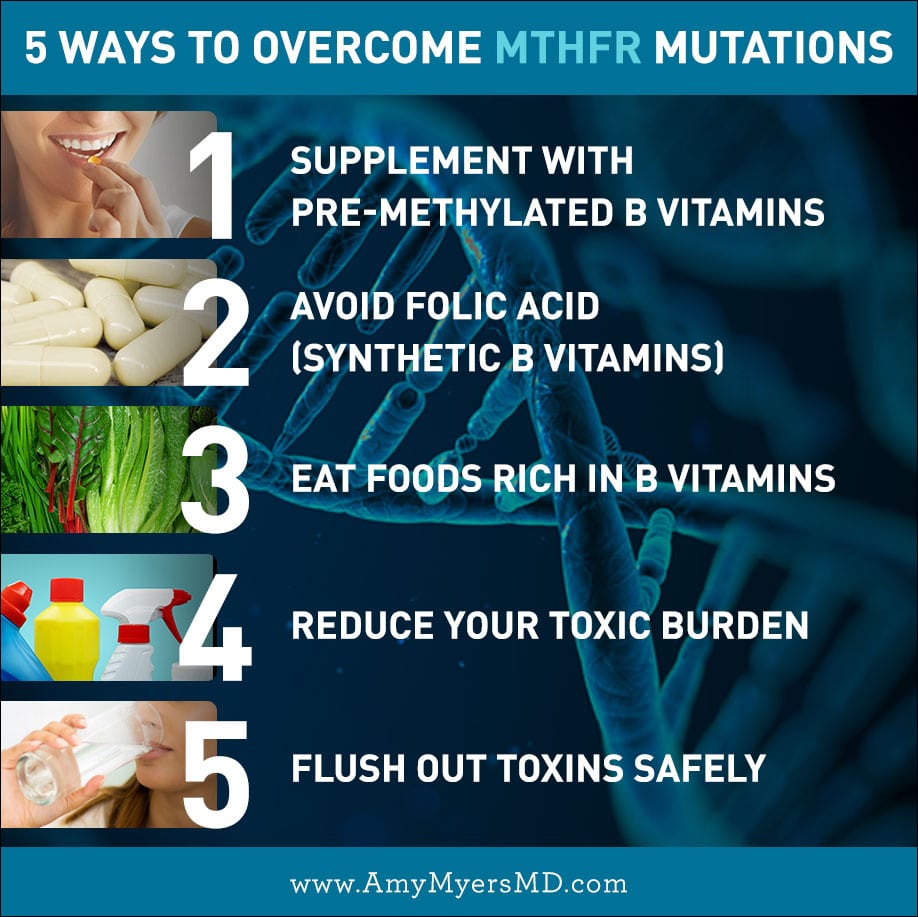
So you’ve taken an MTHFR test and discovered you have one or more MTHFR mutations. You might be feeling as though your genes control your destiny. I get it, trust me, I do. After taking several MTHFR tests, I discovered I have two mutations at C677T. That means my ability to methylate based on my genes dropped down to 10%. It’s likely one of the reasons I developed Graves’ disease. The good news is that there is a solution. By following a few simple steps, you too can work around your genes and get your body methylating again.
 Dr. Amy Myers
August 15th, 2024
https://content.amymyersmd.com/article/mthfr-test/5 Ways To Overcome MTHFR Mutations – Infographic – Amy Myers MD®
Dr. Amy Myers
August 15th, 2024
https://content.amymyersmd.com/article/mthfr-test/5 Ways To Overcome MTHFR Mutations – Infographic – Amy Myers MD®1. Supplement with Pre-Methylated B Vitamins
MTHFR mutations reduce your ability to methylate. So, one of the best things you can do is supplement with the three main vitamins needed for methylation. Folate in its pre-methylated form (5MTHF), B6 in its active form, and B12 in its active form.
I take a supplement called Methylation Support® every day. It contains all three of those essential B vitamins. I recommended this supplement to all my patients with MTHFR mutations. These pre-methylated, active forms of the B vitamins help increase folate levels in the body. They also work to decrease homocysteine levels.
I also recommend Methylation Support® if you use methotrexate to treat autoimmunity. because methotrexate blocks folate pathways. If you have two mutations, even with a supplement to support methylation, you may want to consider different medications. My Autoimmune Solution Program will help address the underlying causes of your condition. That way, you can come off of harsh medications altogether.
2. Avoid Folic Acid (Synthetic B Vitamins)
You might think increasing your folic acid will help with methylation issues. Unfortunately, this is not the case. With MTHFR mutations, your body is not able to convert folic acid well. Taking folic acid in fortified and processed foods is harmful. This is because it can stay in your body unconverted. The unconverted folic acid attaches itself to the same receptors used to absorb folate. In doing so, the receptors get ‘clogged up’ so to speak.
3. Eat Foods Rich in B Vitamins
Get plenty of B vitamins through your diet. The highest folate-rich foods include asparagus, romaine lettuce, and broccoli. You can also find it in avocado and dark, leafy greens such as spinach and kale. Foods high in B6 include poultry, seafood, bananas, and leafy green vegetables. Add more vitamin B12 to your diet with fish, poultry, and meat.
However, if an MTHFR test has revealed that you have two mutations like me, diet alone may not get you enough B vitamins to methylate. You may want to consider supplementing with Methylation Support®.
4. Reduce Your Toxic Burden
MTHFR mutations also reduce your ability to detoxify heavy metals. In that case, do your best to reduce your toxin exposure. Here are steps you can take to limit your exposure to heavy metals:
- Filter your air – Mercury can be in the air near coal-burning plants. Avoid breathing it in by using a HEPA filter in your home and office.
- Filter your water -Due to pollution and runoff, mercury can travel in our water supply. To protect your water, install water filters on all your taps and showerheads. After all, your skin absorbs chemicals, too!
- Remove amalgam fillings – Amalgam fillings contain mercury. They can also emit a mercury vapor that can leach into your bloodstream. For more information on the risks of amalgam fillings and how to remove them safely, check out my interview with biological dentist, Stuart Nunnally. Here we discuss the best practices of holistic dentistry.
- Choose fish that are low in mercury – The Environmental Defense Fund has a list of fish that are high in mercury. Avoid these whenever possible. There is also a preferred list of those that are low in mercury.
You can learn more about reducing your toxic burden in this article about Taming the Toxins. You can also read about it in my books, The Autoimmune Solution and The Thyroid Connection.
5. Flush Out Toxins Safely
Preventing toxins from coming in is one part of the puzzle. Focusing on supporting your detox pathways to flush toxins out is another. Here’s how you can promote optimal detoxification:
- Eat cruciferous vegetables – Vegetables such as arugula, broccoli, Brussels sprouts, and collard greens are rich in and support safe detoxification.
- Excrete the toxins – Drink plenty of water. Optimize your digestion. Do activities that help you sweat, such as exercise or using an infrared sauna.
- Add in Glutathione – This is your body’s most important detoxifier. It plays a big role in reducing your risk of developing an autoimmune disease. Your ability to produce glutathione diminishes if you are not methylating well. I take this every day and recommend it to all my patients with autoimmunity and MTHFR mutations.
- Take a Liver Support Supplement – The one I offer contains N-acetyl, L-cysteine, and alpha-lipoic acid. It also has milk thistle and selenium. Together, these support antioxidant activity and promote a healthy immune system. Liver Support also helps your body’s glutathione production.
- Increase Your Magnesium – Magnesium is an essential mineral in the detoxification process. In fact, it plays a major role in the production of energy as ATP. ATP gives cells with what they need to pump out toxins before, during, and after they accumulate.
- Add Methylation Support® – Make sure you’re taking a methylation support supplement. This and glutathione are the two absolute go-to supplements that I take daily no matter what.
Remember, knowledge is power. Getting an MTHFR test and knowing your MTHFR status is a huge first step in taking control of your health! Even if life dealt a certain genetic hand, remember the unlimited choices on how you can play that hand.

MTHFR Test FAQs
What is an MTHFR Test?
What is an MTHFR Test?
Everyone has MTHFR genes. An MTHFR test looks at any mutations that can occur as a result of over- or under-producing homocysteine levels. An MTHFR test determines if you have one, two, or multiple MTHFR gene mutations.
What does the MTHFR gene do?
What does the MTHFR gene do?
The MTHFR gene is one of the 20,000 genes in the human body. It is a “master instruction sheet” for the production of the MTHFR enzyme, which works as a catalyst for important biochemical reactions in your body such as converting vitamin B9 into methyl-folate, which is essential for a process called methylation.
What are the symptoms of an MTHFR gene mutation?
What are the symptoms of an MTHFR gene mutation?
Symptoms vary from person to person and from mutation to mutation. Conditions that may be associated with an MTHFR gene mutation include cardiovascular disease, depression, anxiety, chronic pain and fatigue, and spina bifida.